|
Mustapha Baqbou: Tim Abdellahs's
earlier Ode-To post. |
All in all, one has to get back to the blogging grinding stone whenever he sees such dedication by other, fellow bloggers like Tim Abdellah (Baqbou post), and tireless many others. Seeing this one here on the blogosphere posted at BodegaPop, urged me to show something in return. The guy named Gary there has taken it upon himself to give us all a whole week of one Algerian beloved Raï singer; namely Cheb Khaled. So, here below is a short 'shout out' on my part for Gary in hopes that this Ode-To post will also be enjoyed by the rest of you dearest bloglers. Enjoy it.
Cheb Khaled (also spelled Chab Khalid) - الشـاب خـالـد:
 |
| Cheb Khaled - الشـاب خـالـد. |
Before we start with Khaled, I have to introduce you to Raï music. Raï* (Arabic: راي/ري. See below for further explanations on the terminology and more), is a form of desert '
sahrawi' music born around the late 1800s in western Algiers. During this huge span of time, the genre witnessed many changes in its very musical core. But, the early singers of this genre were where it's at: called '
chioukhs' (female noun:
chiekhats), which means 'elders', or those in the know of the old style that is the real Raï.
 |
| A Raï dance troupe. 19th Cent. |
In the French-occupied Algiers, the early
maîtres found fame (even when their songs were anti-colonialist), and were much respected for their sound. The early masters of Raï sang about their homeland Algiers in sad tunes formed around a genre that stretches way back to maybe the 1200s (
malhoun), Anadalusi, and poems or
K'ssidas in which they poured their hearts out in accompaniment of a simple reed flute (
gasbah), a goatskin tambourine (
daff), and a hand-drum (
gellal). Their songs weren't called raï music at all: it was... just music.
 |
| Rue de Phillipe - Sidi El-Hourai. |
Soon, and in the early 1900s the songs started to take a rather urban tincture where some of those nomadic troubadours moved to the city of Ouran (also spelled in French as Oran - Arabic: Wahrane - وهران) which was nicknamed 'Little Paris' to denote the abundance of brothels and night-houses or what became known as drink-bars later on in that city, frequented by the working Algerian populace as well as touring, libidinous French soldiers who dug these singers' tunes. Through drinks and sex, the Algerian populace memorized most of those songs by heart to the extent that they became a singular style called
zendani, '
gharbi' or western, and later
'Wahrani' in honour of that coastal city as they were sung by 30's singers like Ahmad Wehbi, Ben Yamina, and Eddoubahi.
 |
| Legend Belaoui El-Houari. |
One of those elders was Belaoui Houari - بلاوي الهواري. Cheb Khaled sang with Houari a few years ago joining forces with his mentor and legend who's credited by most as the godfather and the founding figure of all modern Raï music, or as it's called
raï moderne stemming root and branch from popular 40's Egyptian film-music. Raï has always been heavily influenced by singers like Farid Al-Atrache, and yes, even years later... Lebanese classic ones. Houari's contribution to this amazing music came by replacing the old instruments with those of a more western nature like the acoustic guitar, accordion, trombone, the acoustic (and electric) guitar, and the organ. This made it possible for solo Raï singers to incorporate a band on stage making their sound more serious. Khaled himself joined one of these Raï band ensembles (Ferqat Al-Azhar - فرقة الأزهار) around 1977, and made at least one album with them.
 |
| Groupe Al-Azhar, mid 70's. |
 |
The Earliest known
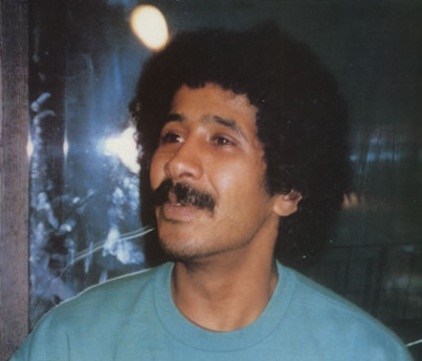
picture of Khaled. |
Cheb Khaled (real name: Khaled L'Hadj Brahim), was born in 29th February, 1960 to a poor family in the port city of Sidi El-Haouari in the '
Spanioli' (or, the Spanish Quarter) part of this district situated in Ouran, and later relocated to L'Kmiel ghasba which has an overpopulation of Moroccans. This district is so close to the Moroccan borders where Khaled and his other two brothers used to go to the small shops that used to sell oil and wheat waiting for any work that would pay them any money. Khaled spent his time playing a small harmonica that he bought with his hard-earned money. He saw a friend of his playing one at his birthday and vowed to get himself a sweet treat.
 |
Young Khaled (right),
with his brothers & sister. |
Later, and with his own tiny hands, he built a wooden guitar that he used to tote around the shops and play smiling with his distinctive child smile that he still bears till this day. Then, he took one of these instruments that we talked about that constitute a standard ensemble at an early age (he was only 7 when he tried his tiny hands at playing any music), and played the accordion at his school. But, being the rebel boy, most of his early high-school days were spent around the bars of Wahran; his birthplace, with his accordion around his neck, sneeking round the bordellos, hanging like a toughie with the cool guys, checking this spot or that for the new 'hot'
mousem stars trying to find a place among the older stage performers.
 |
| Playing at a wedding. 70's. |
 |
With some fans,
playing a piano. |
His father who was a garage mechanic at the local police station did not like the small kid's aspirations and after a few years of banning the young Khaled from playing his favourite instrument, the King Rebel decided to go full-circle quitting high-school. At around 12, his popularity became audible around the city of Wahran's local parties and weddings getting paid 20 dollars a pop (a small fortune at that time for any Wahrani), and soon when he turned 14, he secured a record deal (with an Ourani label called Anwar), to put four of his songs on record playing with some other young singers calling their selves The Five Stars (or,
Le Cinque Étoiles shortened to just '
Étoiles' by his fans).
 |
Cheb Khaled with other Raï Chebab:
Sahraoui (L), Mami (M), Hamid (R). | |
How much was he given for that deal that took place in 1974? Guess? Just five dollars! Whews! Still, these four songs became the holy grail of early Khaled's repertoire completists. He managed to record five more EP-singles from 1974 till 1978 that few, if any... know of their existence. The young Khaled had to suffer the long and winding road of having to work hard to get the enough money necessary to pay for his new habit which grew only faster with time as he joined more bands than any other Algerian singer (his most noteworthy work was with Ferqat Al-Azhar), and learned more instruments (he dabbled with the flute, banjo, and the piano for a while), taking many minion jobs like a janitor, shoe-shine boy, waiter, and a secretariat.
 |
Saxophonist Bellemou Messaoud:
Le Pere du Raï.
Khaled was still this minor singer among the giants who were the real
arbitrators of the genre such as saxophonist and trombonist Massoud
Bellemou, singers Boutaiba S'ghier, Bouteldja Belqasem, etc ... naming here but a few. Then, the young'uns came
with their synthesizers, drum-machines and turned Raï from a pure form of
art into that of a Pop Music one. Algerian Boston-educated producer
Ahmad 'Baba' Rachid took the young Khaled under his wing as early as of
1976 and helped him create a new form: Pop Raï, which later became known fondly as 'Love Raï' with its over-sentimental wordings and romantic style
played to a deafening cacophony of keyboards, incessant drumming, and clanging 'lectric guitars. Raï was never the
same again.
*This developed lately into an odd-ball neo-Raï genre called Raï'n'B (heavily influenced by R&B and Hip-hop).
|
 |
| The King of Raï: Khaled in the 80's. |
 |
| Cheikha Mama Rimitti. |
Some of those old
Raï singers came together and played with Khaled like Cheika 'Mama' Rimitti El-Haqhaniya, and he in return joined forces with the newer generation like the time when he duetted with Cheb Mami, and made a trio with him and Rachid Taha, too. Other popular unisons came also from the Arab pop music world in 2006 when Khaled sang on stage with Lebanese female singer Diana Haddad, and before her with Syrian singer Assalah Nasri, Egyptian pop singers Amr Diab, Mohammed Munir, Angham, plus a roster of many more. His songs spanned many musical genres sometimes hip-hopping and rapping along with world-renowned rap artists, but this had nothing to do with 'real' Raï music. He also tried his hands at the avant-garde alongside Algerian artist Safy Boutella in the 1986 album Kutché (his first produced outside of Algiers by French producer Martin Messonier), which gave him fame in France and Japan.
 |
| Cheb Khaled with Safy Boutella. |
 |
| Khaled with Cheb Mami, Rachid Taha. |
The title 'Cheb' (Young One - شاب/شب) was given to those younger Raï generation of musicians that came a-knockin' in the late 60's. Khaled won his title in 1985 at the Ouran Festival of Music, only to let go of it as he grew older and more famous in 1992. He relocated to France the next year in 1986, and was named a Chavalier des Arts et des Letters by Jack Lang the French Minister of Culture at that time. He holds the French nationality, too. He moved to nearby Luxemburg where he now lives with his three daughters and Moroccan wife Sameera in 'protest' of the racism against his fellow Algerians seen lately in France proving he'll always be the Rebel Raï King.
 |
| Rebel Raï King Khaled, late 80's. |
His fame became a global phenomenon when he sang his most-known song
Didi (ديدي. Trans.: a wordplay on the
adi el-zain part 'to give the beau' mixed with
Hadidti which means many odd words like 'threatened', 'took down', 'saddened', etc...), which got him fans from as far as India, Pakistan, Latin America, and Russia 'cause of its Latin-Afro-Indo-C'arabiean-Moroccanroll styles! It's this
glocal song that made people all over the world know who's Khaled and know some of his songs by heart. Sadly, few know his early ones: those songs that he sang when he was a lesser-known Raï struggling singer. These are his best. Ever.
Cheb Khaled:
from 70's romanticism (R), to 90's new global sounds (L).
The early Khaled still lives in the heart of all Algerians, and Arabs till this very day. The early songs were much aimed at preserving the atmosphere of these hard times that Algiers had to go through time after time, with almost seven French governance rules that sabotaged the country from the early 50's till the mid-60s killing a million, a bloody civil war that cost Algiers nearly 300,000 deaths, and an extremist
Muslimainist theocracy that caused the massacre of almost another million... It's
their song; their
Raï and not France's, or anybody's.
 |
| Khaled with his family in Ouran. His mother is on the left. |
Khaled is like all Algerians: humble, down-to-earth human being who comes from a mixed racial background nevertheless he doesn't have any racism, extremist agendas (unless the west butts in as is the case since the late 90's where they used him as a Polisario freedom fighter poster-boy). Algerians are good-natured people who need to live and enjoy their life with a mutual sound that unifies them into a dance of joy and happiness. Khaled's rarely seen without his famous shit-eatin' grin this humble king of a long lost music. Le rue de Raï, indeed.
 |
| Khaled today: Algiers' fort of sound. |
He returned home to his birth-town Ouran to sing solo without any accompaniment in July, 2011 at Algiers' Independence Day and Youth Day celebrations. Speaking to one journalist about how he sings for women and freedom*, he mentioned that, "this is the real Raï." He fought alcoholism, homicide rumours after the killing of fellow Cheb Hasni, and other media slanderfests and he stood firm his ground. Khaled is the sound of an Algiers that has finally learned how to be free the hard way.
*Cheb Khaled's latest 2009 album was called 'Freedom'.

This dedicatory post goes to Gary's efforts at re-discovering the earthy, raw early songs by Khaled, and his CD posts one after another did a marvie job so far — to say but the least. So, in an ode to his posts, here are some of the 'earliest' stuff that never ever got any hearing at all.
Some of these babes are really old. Khaled's discography can top the 100 and that's just counting his cassettes that he made before reaching the age of 28! Christ on a crutch! Hope you guys can enjoy these uploads at the moment: I will post more 'original' cassettes and LPs by Cheb Khaled later on with better audio-quality and scans, too.
Do enjoy these cassettes Gary and many thanks for being this ever-wonderful devout blogger.
In the meantime... I be back to my self-imposed hiatus.
'Scuse me while I kiss the sky!
Bye bye.
Early Recordings:
(كفيش ننسى سعاد - How Can We Forget Souâd).
(روحي يا وهران - O'My Soul! Wahran!).
(يـا شابة - You Young Female One).
(تيجي لا بغيت تيجي - Come, Or Don't).
(إنتا تدير, وانا دير - You Roll And I Roll).
(ما حلالي نـوم - Sleep Has Departed Me).
(سهر الليالي - Oh The Sleepless Nights).
(مانيش منا - I'm Not Like Her).
(خلوها - Leave Her Alone).
(بحري - على الزرقا راني نسأل - Seaside - I Seek The Blue-Eyed Woman).
(طريق الليسيه - The Road to High-School).
 |
Trig El-Lici EP - Anwar Label
featuring a very young Khaled. |
Bonus:
Compilations: