Showing posts with label Popular 80's Arabic Music. Show all posts

5/25/2012

Intermission: Bonus Compilation - Lubnanyat Zaman - لـبـنـانـيات زمـان.

Attenshun Shoppas!

Callin' on all blogsters who frequent these e-quarters:


Fairouz.

Continuing with a bonus for the last two Intermission posts... this here is a big Compilation that I myself has made with many Lebanese singers and bands (some are very very rare), taken mostly from the 70's and 80's for your special e-njoyment.


Lubnanyat Zaman Comp's record sleeves and cassette jackets.

Each track here features a different artist or band (and, few are collaborations with other artists) and they exactly number 75 Lebanese pop singers from the 70's and the 80's. I also wanted this new comp to be special like the first one... so, I made a nice front-folder for it from most of the original cassette and LP sleeves.

After all and all, it is a good-naturedly quickie look at past happier times in the Middle-East when people were carefree and cool.
Smile as you listen to these happy songs.

I go now. Stay hip, people.


⊰ ✇✇✇✇✇✇✇ ⊱


Extra Mini-Post:

Old wall drawings showing debke dancers.
The History of Debka Music:
دبكة, or دابكة (debke/ dabka/ debkah) is an old style of line-dancing that originated around the Mediterranean basin in ancient times. Not much is known on its earliest origins, but the Greeks had a similar Bacchanalian line-dance in which the dancers held each others' hands and moved in a circle. That dance resembled a huge human circle that erupts from a long line of at least 4 dancers who dance so closely as they moved in slower movement to whatever music which accompanies this terpsichorean enchantment. The Greeks enacted these pagan dances on special occasions such as when the Moon was full, or rather as a worship ritual for the Sun.
Mesopotamian musicians.
The circle itself depicts the Sun, and the dancers become the revolving cosmic planets. Some certain order was placed around the Mesopotamia for closely related dances that are said to enact the power of old Gods inside their dancers. But, nothing is known about these now-dead rituals. Religious symbolism of the dance itself is scarcely studied and nothing could be found in any theosophical reference about these dances, but I guess the dancers were a structuralized universe; a unison of bodies and souls. Modern-time line-dances vary so much, there are few similarities left to see now in any of these to those of earlier times. That said, the Mediterranean sea (and, the Middle-Eastern part of it in particular), and its countries have so little differences between them and most of the dances found there are really the same. For example, modern Greek dances are almost the same as those in Egypt, Jordan, Syria, and Lebanon. Also, Eastern European countries so close to Turkey do not vary much from Turkish dances and other forms of Turkish music.
An Egyptian dancer in a trance.
Debke itself is thought to have originated in the Balkan region of East Europe, and was taken to the Ottoman Empire at the 16th Century when Turkish imperialists invaded these parts of the world. At the starts of the 19th century some of these Balkans took permanent residence in the Levant region and became naturalized citizens bringing in with them their crafts, music, and dances. Debke was one of those. The Balkan dwellers in the Levant were known as master builders and masons of a high caliber. Their knowledge harks back to hundreds of years of generation after another of builders who had to build reliable houses in extremely cold climates. Building a house was an opportunity to gather people around who used to help with it in the spirit of community, and calls to help that were actually sung in rhythmic tonality to make it more acceptable for other villagers to come and share the hard work.
19th Century painting of a darbuka player.
People started and finished with a dance: debke was the finishing finale where the builders took a rest by getting together with the rest of the master builders or foremen to announce the finishing of the house in a stomp dance. They used to gather at the roof as it was the last part of the house to build and as they did with normal dances on the ground, they moved together in a circle and broke again in a linear dance all the while their hands held up high as to make their feet stomps more powerful to compact the mud roof. The word debke is taken from the Arabic root د-ب-ك which means 'moved', and has many similar root-words to those of animal-walking sounds, and the animals their selves. The Greek dances of yore were animalistic rituals of pagan dances and sex played a vital rule in these dances, especially where the bachelors got to dance at these lines on top of the roofs, as these houses were built for marriage purposes and/or those intending to get wedded.
Iraqi-Kurdistani troupe of debka dancers.
At those older times, debkes were male dances, and the women (even in Eastern Europe) had their own special dances that men weren't allowed to share. But, with time the dances became uni-sexed and a very good initiating opportunity to meet new mates to marry, but touching hands wasn't allowed. That's why in a debke — and until these very days, a woman must hold a handkerchief in her hand, and the males, too. Not all males: only the rayess (leader) is the one who's supposed to hold the kerchie as he twirls it around in fast circles in the air. In old, Christian East-European times, people used to walk outside their churches dancing these dances and holding a rosemary or any praying beads in their hands raising it in joy and celebration of the newly-weds. The Middle-east has this, too: a leader, or sometimes anyone of the laweeha (the dancers who are able to muster this art), holds a rosemary (called masbaha) as women twist their tongues in zaghareet/walaweel (زغاريت/ولاويل: shouts of joy using the mouth and not the lips) to announce their joy to as far distances as they could.
A dancing group of debke in Iraq.
As the dance starts, the first instrument to begin playing is usually the reed flute called yarghoul/arghol/maghroun (a Turkish word which means 'the announcer'), or sometimes in Syria, Lebanon, and Jordan the mejwiz/shabbaba (entwined double reed-flute) is also used. The rhythm starts very slow in elongated sharp tunes as the dancers warm up in slow motions holding their heads down, and moving in 1-2-3 steps (one front, back, front again and then move to the side), hands start to clutch and the line gets created. There is also a singer who sings in mawaweel: old, short, memorized poetry usually of two couplets which he fires at the top of his lungs in a shriek (this is not a song, mind) and sometimes places his hands (palm down to his face), to cover his ears as he shouts. This is just the start of the debke. This dance is like riding a steep high-cliff on a bike, and when the lead singer reaches the apex... everyone joins, and dances and the ride becomes a very hectic down-hill jamboree that might last for hours nonstop. It's just like sex in all its animalistic expressions played to the beat of a flute and a drum.
A yarghoul player from Syria.
The drum's called tablah (or, darbouka/darbokah/derbake) and is usually played by women, and not men. But, now everybody plays it, even I do play it myself. The words to the lead singer's songs usually come infused with sexual stories of how he's asked the lover to come talk to him without anyone seeing them, or how her new haircut makes him wild or how not paying any attention to his flirting has caused him to lose his mind, ... etc. The most common of these songs are dalouna: دلعونا/دلعونة it's a call for help which originated from those same Balkan builders as they shouted these three words Ya Tha Al-Aoun for God to help with the hard work. Other styles are Shemali: شمالي/هوا الشمالي the singers start by calling on this unfavourable wind to tell their sadness about some matters. (Note: the wind itself is God. Most Levant religions has the soul as the source of Godhood inside them. In Judaism it's called rouach, and in Islam rouh. Wind is called reeh, too. The Shemali wind comes from the left side of the earthen hemisphere, and thus one can see a daemonic relation here. But, as usual nothing is really known about this).
A debka in southern Palestine.
Women in the Levant have this habit of burning incense weeds, or throwing perfume on the air which is a way to rejoice the company of the dancers (in olden times, they were from the village and took nothing as a monetary reward for their dance; maybe just the dinner presented at the end of the celebration. Now, the dancers are all paid, or hired), and they thank the singer and his troupe by ululating more and more and louder and louder. A singing style that greets the singers and the guests as well is called Maijana (Ya Min Jana: ميجانا). It's a welcome call for all those who came and accepted the invitation, or even those who are just passing by. One style of debke songs is called Zareef (زريف/زريف الطول), which is sung in Lebanon, Palestine, and Jordan, mainly. The word means one who's as tall as a giraffe and this means the high-status of his honour among those who know him. It's not the groom, no. It's someone imaginary for whom the song starts. The singer's always asks him to just pass by, or stop and... "let me tell you..." in fast rapid words of two couplets.
Debke.
Other styles of debke dances common in Syria, Lebanon, Palestine, and Jordan are: the jonoubi dance (southern), sha'rawiyya (has six measures), karradi dance (from Kurdistan originally), sahjeh (accompanied by hand claps), jafrah (Palestinian dance from the Jafra region in Baqa Al-Gharbiyah town), farradiyeh (Jordanian women-only standing debke), dehyyeh (bedouin wedding dance common in Southern Syria and Jordan), tesa'aweyah (nine measure debke of the south of Jordan). The lead singer usually asks the dancers to "sallee a'ala nabi" at the end of the dance, or to wish peace upon the soul of Prophet Mohammed. Amidst the dance itself, he directs every step with his kerchief, or masbaha, and some even carry a bamboo rod or a sword as a symbol of leadership placing it high on top of his head, or sometimes even touching the ground with it to announce the lower movements, or those dances that get the dancer closer to the earth, all the while staying so close to the man next to him (sometimes leaning on him with the side of his body). At other times when it gets 'hotter', he flees the line and hits the ground with all of his might in a thudding cloud of dust! It's amazing to dance and/or watch debke in action.
A debke band in full action. A 'Laweeh' at far left.
Other modern related dances and singing styles are: sahbet ouf/ouf-ouf (an atabah singing style that starts always with repeating the word 'ouf'; an exasperate shout), abu-zelouf (a romantic singing style that speaks to an imaginary abu-zelouf, or one who has thick side-burns), a'wadeh (Lebanese dancing and singing style that starts with the words "a'ala Allah te'oud": oh may those days return. A very nostalgic, powerful, sad singing style), wahda-we-nous (1.5 measure which can also be danced to a debke tune), raks al-a'sayah (staff dance using a small walking stick), raks sharki, raks baladi, raks badia... etc.

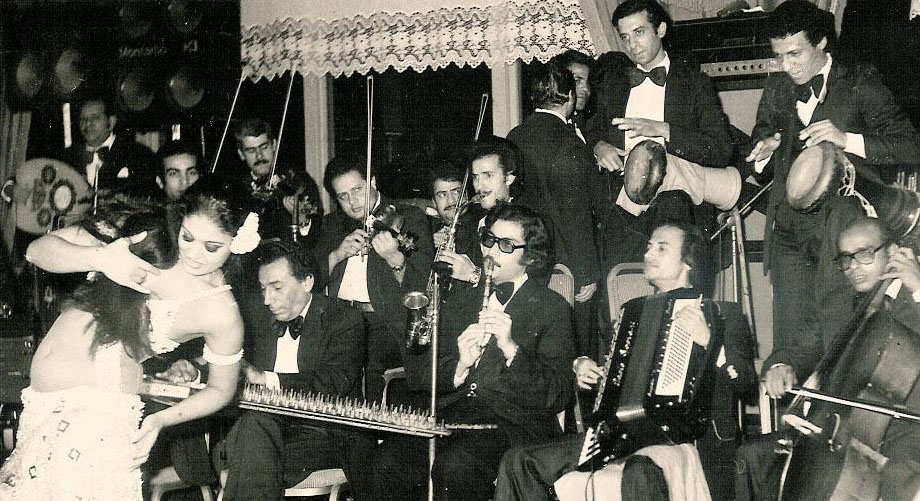
Syrian Raks Baladi orchestra in the early 80's.


⊰ ✇✇✇✇✇✇✇ ⊱


Right awn!


H.H.

5/08/2012

Sadoun Jaber: Iraq's Pat Boone? - سـعـدون جـابـر.

Oh'kay... I'm back by urgent demand.

*breaks the silence*

I had a request yesters from one of my Iraqi friends living here in Jordan after seeing the Cheb Khaled post at these Audiotopic quarts. He kept reminding me of how my joint was devoid of any 'Iraqi' singers and to tell ya the truth, I felt sad 'bout it 'cause Iraq's one of the richest countries in the entire world, musically and historically-speaking, and it deserves a lot of blog-space.

Well, in terms of writing this new blog-post it seems to get sadder when one ruminates the war that still ravages Iraq. Add to that the fact that these treacherous blawggin' waters are shit-magnets abrim with Amerigoons who are nothing but born-to-hate-360
°-chrome-plated-revolving-inverted-Americanus-holes to the inᵗʰ degree and one has to tread at ease in their midst.

But
—  at least for me, it gives me a much-needed cowboy proddin' poke this intrinsically growin' hate that they posses deep within. That 'Raqi guy 'hammered in' the last nail by showing me a small Various Artists compilation which he'd gathered from some Arabic music sites. Regardless of the sound quality he's got there, it surely put me back to the blogging chair in a heartbeat:
The music he had in it was just marvelous!


On and on, and through listening to these 80's-70's old Iraqi songs (some of which I'd never even heard or knew at all), I quickly had to chose one of these singers as a "post subject"... and lo and behold, I picked Sadoun Jaber: Iraq's best crooner ever, and the voice of a country that no longer exists thanks to America's invasion of this Middle-Eastern country that was known once as the 'Cradle of All Civilizations'.


The War:
Beautiful Ahwaz region in southern Iraq.
For more than 25 years and Iraqis have been suffering the world's worst humanitarian tragedy that has kept their beautiful country Iraq (العـراق) under the strict grip of consecutive wars instigated by greed and a never-ending lust for power. There was no letting go off of such a dire situation in a country that the British colonialists set their eyes upon a long time ago ever since oil was discovered in the 20's of the last century in this large country full of gas, oil, and natural resources.
Saddam Hussein in the 80's.
Communist Russia was given the 'go' in the late 50's by those same 'Allied' global powers and in less than 20 years, it had over-all control of the country in a clandestine operation which came to a boiling point in 1979 when Saddam Hussein took over the ruling seat forcing his country to enter into a series of spasmodic wars: first he went to war for 8 years with neighbouring Iran that ended with him declaring the country bankrupt, then he invaded also-neighbouring Kuwait  (called the Persian Gulf Wars I-II, 1980-2003), and the story's still rolling on.
The Second Gulf War, 1991.
The Iraq-Iran War - 1980's.


Sad as it seems, millions of Iraqis died in these wars as their country fell prey to what I myself call the ignorance of the masses: how can anyone not fight for his or her country? True. But, why should they fight for one (So-Damn-Insane as he's called by M60-totin', boorish Marines in the 90's) person? This is bloody fucking pathetic! America placed him and then allegedly hanged him, and is already establishing its mini-Empire there with multi-billion projects at stake. These innocent Iraqi people still die at unprecedented horrifying
rates.

Guys, no time for bollotics and what-all... Fuck America for a game of ten toy tin-soldiers: America is a non-'cuntry' and will fade soon, trust you me. It has no future because it never had any past. Read this article if you want to hear the story from the Iraqis' side. If you might feel a bit too pacified by  spinformation media, then suit yerself: the truth is far more clear and dear than try 'nd present it to a 'dumbmericunt'.
Make Noise, Music, Art And Love ... Anything But War.


Let's read instead the story of Iraq's best-known rural-pop (or, rif
i - ريفـي) singer. Righto, babes?


Sadoun Jaber (Also spelled as Sadoon/S3doon El-Jabr) - سعـدون جـابر:
Iraq's Nightingale: Sadoun Jaber.
Born Sa'adoun Jabr (سعدون جـبر) in 1951 in Nahiyat Ali El-Gharbi (ناحية علي الغربي), a small, poor neighbourhood in Amarah (العمارة) townlet situated in the middle Euphrates part of the Miessan Governate that sits so close to Al-Ahwaz in southern Iraq. His family moved to the capital Baghdad (بغداد) in the 50's. Sadoun's father was a mosque leader or imam who frowned at his son whenever he started to sing. Taking up many hard-working jobs (brick-layer, carpenter, fruit-seller), Sadoun wanted a break out from this hard life and began singing and playing the oud around Sikak Gardens (حدايق السكك) with fellow singer Fadel Awad (فاضل عوض).

During these early years and aged only 13 in 1963 he won the Rukn Al-Huowa contest (Ameture's Corner: a music-talent show that was aired in the early 60's by Iraq's National Radio), and then he joined the Ferqat Al-Inshad choral band as a muraddid (repeater: a back singer) who repeated whatever lead iconic singer Mohammed Al-Qubanchi (محمد القبنجي, left) sang, which was such a great honour for the few winning young singers, among whom Sadoun shared the singing contest like Fadel Awad, Daoud El-Qiesi, Hadi Hafez, and Aref Misha'al.
Singer Yousef Omar.
The first styles that these young singers tried were the same, ages-old Iraqi Maqams sung by older-generation singers like Hudhieri Abu-Aziz, Dakhel Hassan, Yousef Omar, Ustah Hussein, Aref Mouhsen, Mohammed Al-Faqanshi, Abd Al-Amir Al-Touierjawi, and female singers such as Salima Basha (a.k.a. Salima Murad), Maeda Nuzha, Ansaf Munir, Ahlam Wehbi, Setyaha Muniak, and Anwar Abd Al-Malik. Sadoun's songs on the radio got him much popularity among the Iraqi listeners keen on new sounds, but that wasn't enough. His first song recorded at Iraqi Radio in late 1972 went in the can after finally being recognized by the elders for his immense talent. These elders were very picky at choosing the new star singers as to preserve their thousand-plus years musical heritage and keep it intact and safe from pop influences.


Nazim Al-Ghazali
on T.V. late 60's.
Sadoun and many other Iraqi singers used the maqam style riding on the fame of one Nazim Al-Ghazali (ناظم الغزالي: he met him in 1964 and in his words, "looked at me, smiled and just patted my shoulder"), who was a stable feature at almost all Arabic late-60's television stations that used to air his black-and-white songs over and over. Sadoun began by not taking lessons as this style is learned by only listening. It's sometimes called sama'i or the music genre that one should listen to. From that date on and for the next ten years or so he himself became the stable singer and was called to sing at parties (haflat/sahrat), witnessed huge television popularity and soon afterwards with enough money in his pockets, he enrolled at Al-Muntasiriyah University to study English Literature.
An Iraqi young talent contest, 1984.
After his graduation, he left Iraq for another ten years to study at Salford University in Manchester, England (where he met and recorded with the music-meister Baligh Hamdy), then after returning back to Iraq he joined the National Arts Institute in Baghdad in 1985. Sadoun went to Cairo, Egypt to study at the Higher Institute for Arabic Music (Al-Ma'ahad Al-A'ali Lil-Mousiqa), gaining his doctorate in 1986. He holds five academic degrees in various subjects. His doctorate thesis was about the role of Iraqi woman in the development of Classical Iraqi music. To explain further, way back in the 50's, women singers in Iraq were accepted as part of this huge heritage of folklore music. In 60's Iraq for example, there were about 30 female singers who were famous, but in the late 80's this number dwindled to just 5!
The genius and the genie:
Baligh & Sadoun, circa late 70's.
Music-wise, Sadoun work was centered around the old traditional songs that most Iraqis know, and those songs that were 'given' to him to sing by well-known Arab writers and poets such as wealthy Saudi princes Khaled and Abdallah Al-Faisal; singer Abd Al-Rab Edriss, Sirag Omar, Badr Bin Abd Al-Mouhsen, and famous Egyptian composers Abderrahmane Al-Abanoudi and Baligh Hamdy. His music career can be divided into three main stages: his first with Iraqi composer Kawkab Hamza, then Mouhsen Farhan and after leaving to Egypt with the genius Baligh Hamdy who composed 4-5 songs for him (namely, Min El-Awwil Ya Habibi, Mishwarak Habibi, Rouhna Wallah Rouhna, Ariedak Ana Koul Youm, and Moushkilah) in 1984 at the height of the Iraqi-Iran war, before that he worked with Iraqi writers and composers Kazim Fendi, Abd Al-Hussein Samawi, Talib Al-Kouraghouli, Mohammed Jawad Amouri, Sadoun Qasim, Zamil Saïd Fattah, Kazim Ismael El-Kati'e, and Zuhier Al-Dujieli among many others.
Party poster. 1983.
The most famous of all of his songs was Ya Teour Ettayrah (يـا طيور الطـايرة - 'Oh Flying Birds'), chosen in a 2006 B.B.C. poll as one of the best 100 Arabic songs of the 20th Century which he sung in reminiscence of his beloved country Iraq while being away in ghorbah, written by the Iraqi poet Zuhier A'dujieli, which 'flew'-spread to the rest of the Arab World by way of Syrian poet Mamdouh Edwan in 1979. When he sang this song on stage, it sometimes brought a tear to his eyes from longing for his homeland as he had to stay far from all the war going on. It was the outro song he always finished his live encores with, stating once in an interview that, "after Ya Teour... there aren't any songs left for me to sing." The song is still being sung today by millions of Arabs; shown on T.V. as if it was 1972 when he first sang it on radio. It's his best, really.

His Music:
An early 90's Iraqi Maqam band.

Around 1985, he spent his time focusing on academia and research, and chose the Iraqi maqam as a very distinguished style of old, classical Arabic music (see the linx below for more information on this genre). Its earliest beginnings were in Baghdad; the capital of Islamic Abbasite Cliphite (also called The Abbaside Dynasty 750-970 C.E.). The word came from 'qam' which means literally 'stand', because back in the olden Muslim ruling days of kings, the invited lucky audience weren't allowed to sit down on floor rags in the presence of the caliphate. Not even the band was allowed to sit, too. It was a music of grandeur and overwhelming ecstasy. Other later styles he took interest of where rifi (very rural folkloric songs that became famous in the 40's and 50's mostly coming from the southern part of Iraq), abouthi/ abouthiya (أبوذي: a poetic rifi style that starts with formal Arabic couplets), and dami style which he sang wearing the traditional bedoui ikkal (a thick, Arabic headdress made from goats' hairs worn by Bedouin men), and abbaya (long, flowing light-coloured formal dress of distinguished shioukh) right on T.V. behind a backset of reed houses very common in the south.


Singer, composer, and oud-player
Baligh Hamdy.
In 1976 he was invited by the Communist Nasserite party to sing at the Voice of Arabs Radio (Sawt Al-Arab), in Egypt in commemoration of the opening of that famous radio in July of that year. He met there Baligh Hamdy who was impressed by his voice which has a distinctive croon, and a tad gruff but coy undertones. After choosing some songs to put to record together, Sadoun left to England where Baligh met with him again to put his voice to the musical arrangements that he himself made especially for. This was the height of his career being recognized first in his homeland, and then by the best ever Arabic composer who've ever lived: Baligh Hamdy (Arabic: بليغ حمدي . Check this wonderful blogsite its owner has adamantly collected almost all of his songs and compositions for other Arabic pop singers. Unmissable!).


Singing at Studio '86.
It is said that Sadoun wasn't another copycat act like most Iraqi singers of his time were. Some think he was maybe just another Tarab singer like say Abdel-Halim Hafez was, but his Tarab was so special that few today (if any), can sing his songs or remake these into new 'covers'. He was so special, even Hafez is so easily copyable. Not the case with Sadoun Jaber: his voice has a jawab ('answer') and qarar ('deep octave') that has secured him a place among the best t'Arab singers like Wadeh Safi (Lebanon), Sabah Fakhri (Syria), and many other tarab-i Egyptian masters. He was known in Iraq with his ability to sing a very hard maqam called 'mukhalif' which means the 'unlike other maqams' because of how hard it is to muster. Among the multitudes of these maqamat that can reach a few thousands, he sang in sa'ab (hard), saba (youth), and llami (start with Lam-letter in Arabic 'ل').

Singing Ya Oumi live on T.V., 70's.
Most popular Iraqi music has this deeply-seated sad ring to it. The songs come as cries or shouts of sheer pain and regret themed after tragic love stories (fictional, or real), departures, broken promises, cheating lovers... etc. One of his saddest songs, called Ya Oumi, or 'My Mother' has so much sadness almost all Arab pop singers have tried to remake (even schlocky, over-madeup Syrian female singer Ruwaidha Atiah sang this über-sentimental song not making it any better). The only other song that almost 20 Arab singer redid was Loh We Lou We Laoua ('If, And If And What If') with its simple, uniquely-upbeat rhythm that surely was the reason behind its popularity in the 80's.
The Nightingale and his oud.
The newer generation of Iraqi pop singers loved Sadoun Jaber, and some worked closely with him save for Kazim Essahir (كاظم الساهر) who was so jealous of his fame and musical talent romour has it that they went head-to-head at it trading insults. Sometimes their fights took an ugly form where Kazim was described by Sadoun as deforming the Iraqi popular song into that of other Arab countries' styles only for the latter to start bad-mouthing a legend of a singer like Sadoun Jaber who can be considered the greatest master to this Sahir pupil. (Note: Sadoun's remarks are spot-on: Kazim Sahir's music is yawn-inducing and has no particular style let alone an Iraqi distinctive one). Sadoun paid homage to older singers like Qubanchi in a number of T.V. serials taking the lead role as a tribute to their sounds.
Young singer Salah Abd Al-Ghafour with Sadoun Jaber (R).
He is active in folklore music conservation being an academic in this field. Among the 2070 singing genres that Iraq has, he documented 10 of these known around Hay El-Amarah where he was born: a 5000-year old place that speaks volumes of Iraq's old heritage and art and Sadoun's roots. Named in 2008 a "Good Will Ambassador for the U.N."... among the many nicknames he's called by was the 'Arabian Nightingale', and 'Ambassador of Iraqi Music' outside of war-torn Iraq in the Arab World, Europe, America, and Australia. Sadoun lives now in Damascus, Syria away from the Iraqi war. But, what's being labeled now as 'youth revolts' fully backed by the U.S. tyranny of death, blood, and hate did not leave that ageless city alone. It's such an atrocity, really.
With his wife at a gala dinner, 00's.
The Great American People (or, 'non'-people, mind) never had any culture of their own like say, Iraq or Syria. Americunts are committing the worst crimes against the world's oldest cultures with their envy, hatred, ignorance, and greed. This story isn't about music: No, not at all. I am just reflecting on the feelings of many a million Iraqi citizen and a couple or more million Arabs who now 'ave become part of this world-wide diaspora of refugees without any home to call their own. First it was Palestine, then Iraq, and after that Libya, and now Syria? Such improbable vileness! These nad-knockin' 'MerryCunts will pay greatly in hurt-ass units. This Universe keeps its own records.
Sadoun Jaber - ســعدون جـابـر
The immortal  voice of Iraq.


Discography:
His discography is a mystery to most scholars. Actually, and in the Arab world, there is no such thing as a 'pop music scholar'. Throwing here a ballpark figure, his cassette albums can reach in the neighbourhood of 25-30. Most of these are lost gems nowadays and should be sought by the ardent crate-digger. I shall give you 'ere just a small look at his work, upping five of his cassette albums taken randomly from various stages (plus a comp 'Ya Oumi' of his best songs and a 'Best of' Album that I myself have compiled).


Enjoy.

The Maestro of Pop-Folk Iraqi Music: Sadoun El-Jaber.


Useful Blogs:

-History of Iraqi Music.
-Iraqi Maqam.

Iraqi Music-File Sites:
-
Iraqi Music Files.


Good news to cheer us up from all o'this sadness laying so thick 'round you could cut it with a knife? Or, maybe bang it with a hammer? Mhm?
Lebanese Singer Mohammed Jamal.
I have uploaded all of the remaining Lebanese 80's (Vols. 1-12 Plus Bonus) albums, and they are all available for download, babes. My fave of all the 'zactly 543 songs is Mohammed Jamal's funktacular Meeli Ma Mal El-Hawa ('Bend With The Wind') that he sang with Syrian-Turkish singer Taroub. It has it all: cool repetitive claps, danceable bassliness, wo-woo synths, groovy back-singers that can set the laziest tush into a bang-bang dance.

'Member: there isn't a single compilation in the world that can touch this one's sky, or feel its ace. It's the ultimate one. I fuckin' didn't mean to keep the comp on the back burner, so I stopped holding' my cawk doin' nothing and bang! finished upping it today. Listen to the 'sound' while I'm gawn, and stay tuned for moar.
Ah-mazingest! Enjoy these and the more to come from... Audiotopia.

Guess I can go home now... uh, safe.

Yee Haw! *Whamfartsbananamerica*!

H.H.

3/16/2012

Osiris: The Bahraini Pink Floyd? - أوزيرس.


Ya Halla!

The last posting for The Jets was jus' marvs. I had to return once again to Blogsville as if transmogrified by a magical spell from that ancient land to up one of their Live albums as a bonus (Note: I thought twice  about doing so as some of the tracks there had hiccups and are repeats from other albums, but I did it anyway being quite the completist). And, from what I've seen at Stats, it's got a good 'blogle-age', too. This makes me 'appy, guys. So, keep on listening and DL-ing these wonderful tunes that never really got any airing befitting their musical and historical status.


We will haul ass now, leaving Egypt (not completely,though), to a tiny island in the Persian Gulf called Bahrain to feature its best-known and 'heaviest' band ever: Osiris. Plus, a brief introduction to Bahraini bands' scene of the 70's and early 80's so scarce and little known outside of Bahrain itself. Get ready for jus' another rare rock show from the Middle-east only on Audiotopia.


Osiris - أوزيرس:

Osiris playing on stage cicra 1986.
Osiris is an ancient Egyptian God declared the God of Resurrection and Life and Death, and the Underworld many thousands of years ago. This band has strong roots to this on-again, off-again cycle of life-and-death as two points. Their early formation in 1969 was a beat band (Witch), playing rock and roll hits like any Iranian 60's rock bands which we all know of, and love to smithereens. Iran has a close relationship to Bahrain and most of Bahrainis speak Farsi. They both share the same history and quite like Iran... Bahrain dates way back to prehistorical times when it was a Delmonite kingdom. It was declared a Kingdom again in 2002.

Osiris is a unique band taken from different points. It has a very early start at a place that barely has any band to speak of. This band didn't just break chronological norms, but also did create a new sound so progressive, and inventive, it became known the world over and has a great, rapidly growing listeners and fans-base alike.

Leader Mohammed Al-Sadeqi - محمد الصديقي.
The earliest members of Witch were Mohammed Al-Sadeqi, who played lead guitar and sang in his not-so-bad English, his younger brother Nabil who was the sticks-meister, and cousin Mohammed Haydan who played the electric bass. The Sadeqis later asked their older sister Faiqa to play the organ as early 70's rock bands were made of these four essential instruments. They played privately in parties and rock youth gatherings, then the Sadeqis left to study in the U.S. and the U.K. (people in the Gulf area back in the 70's were maybe, the richest people on earth sending their kids to study at the most expensive universities in the world because of the oil-dollars these Gulfanarian 'cuntries' posses). And, the band broke up in 1974 and reunited only when the brothers returned back home after six years.

Mohammed playing lead live in 1984.
When the Sadeqi brothers came back, they wanted to bring Witch to life again, asking bassist Mohammed Al-Shafee (he also played later the organ), and Sami Al-Jamea (organ) to play along with them. The band grew into a six-member unit with the addition of yet, another keyboard player (Abdel-Razzak Al-Aryan, ex-Sharks member which gets a well-deserved review here on Part II: 'Bahrock Bands': Early Rock Bands of Bahrain), and rhythm guitarist Amin Qahwaji choosing the name Osiris to depict their hard rock interest playing to but a small audience of mostly drug-crazed Bahraini youngsters in secret hide-out houses.


Issa Janahi live on stage mid-80s.
After few rehearsals and an intent to make an album, they wanted to get a singer to sing in good English, and the choice came on a nice-looking gentleman whose name's Issa Janahi. And, the rest? Osiris' first official concert was held to a gawkfest of Bahrainis who watched the band play their first 'super-band' gig at the Rabia Al-Adawiyah girl school hall wearing psychedelic garbs and standing like real-ass heavy-sters such as Pink Floyd and Genesis.


Osiris live at Al-Adawiyah hall.
Back at that time, there were no such thing as 'recording studios' whatsoever in the state of Bahrain. The only working studio in that Shii'te-majority country (they looked down on any western forms of cultural manifestations as a dire threat on their orthodox beliefs), was a small one-apartment studio called Eagle (Al-Nasir). Another session player (Nadir El-Rafie on stand-up conga drums) joined them to record the album's eight songs in late 1981 and early 1982.

Bassist Al-Motawa'a with lead Mohammed Al-Saedqi live.
The band also needed to send the reel-to-reel master tape outside of Bahrain in order to press it as there were also no labels at all. The album (self-titled) was pressed on a private Philippine-based label (WEA), which sent the 1000 copies back to Bahrain. Some of these were again sent to Bahrain's radio jockeys who played the album hailing it as a revolution in Bahrain's music history. And, they're absolutely right: Bahrain had a measly rock scene, but its folkloric music and national (as it's called there 'wataniyah'), music is the most prolific and documented music in the Arabian Gulf region.
Jalil Abdallah (left) Jahani (mid-pic) Mohammed (right).
Success didn't come flying in their way with colours: the band decided to break up one more time, and two of its members left to study abroad. In late 1983, they played live on Bahrain's national (and, only...) T.V., and by 1984 they were ready to pin down their second album after a round of successful hotel-concerts played here and there by the end of that year, naming the album 'Tales of The Divers - Live' which included some Arabic songs for the first time sung by Ferqat Al-Wehda Lil-Finoun Al-Taqlidia ('The Union Band of Traditional Arts'; a good sign of the band's reverting back to their Arabic/Bahraini roots in this concept album).
2nd album Tales of The Divers 1984.
3rd album Myths & Legends 1984.
4th album Reflections 1986.
Visions From The Past - 2007.
(Note: none of these albums are available for download because of copy-right issues).


Meanwhile, the third 'studio' album recorded was being recorded in 1984 (Myths & Legends): an awe-inspiring, synth-driven attempt at braver sounds which encouraged the band to keep as a single, solid unit without any further lineup changes (two members also quit to study abroad at that time). It was the band's highest time for creativity. Most of their earlier albums were so filled with sensitive lyrics and melodic rock somehow bordering on the nostalgic part, not to mention their deeply-influenced spiritual inner hints at magic practice, other-worldy existences, etc... trying to keep sane in a world that does not spare you your mind, but gives you mundane, worthless solace in materialistic abundances in countries like the uber-rich Arabian Gulf states.
On stage, Bahrain, with Debbie Moss
who joined them as a keyboardist.
The band's 'third' album (Myths & Legends, some say it's their second), was in the works, too and through their friends from the Philippines (Pinoys are ten-a-dime in the Gulf states and they leave their country to work there for a few bob), the band arranged to perform live there when some of the ex-members came back to join for this first outside-of-Bahrain major International concert in Manila in 1986. The Sadeqi brothers' youngest (Sabah Al-Sadeqi), also came back from the U.S. forming at first, another heavy rock band named Requiem but after a few gigs, he quit to join Osiris for their fourth album in early 1988 called 'Reflections' which was released officially in 1990-91 by the music label Musea. The band went afterwards into a musical coma whether because its members got busy with work, life, family, or just simply quit.

The full band on backstage 1984.
In the late 90's Osiris started to play and record together again, and the resultant album (Visions From The Past), was an ode to their lifework and those ex-members that passed away. The album included some classical music undertones which was so progressive to boot. Then, and in 2010 another 'pure' progressive rock album (Beyond Control - Live) in which they played their most popular songs was recorded and released. A year later, and in 2011, the band that tried to stick together throughout the years issued their swan song album after they got their collective asses to the grinding, recording-stone to release their last album ever titled 'Take A Closer Look' with the band's fullest current line-up of Mohammed Al-Sadeqi on lead, Ahmed Al Qassim on bass, Nabil Al-Sadeqi on drums, Khalid Al Shamlan on keyboards and piano, Abdel-Razzak Al-A'aryan on keyboards and synthesisers, and Ahmed Ravanbach as their vocalist.

The band today still rocking the world in 2010.
The band still plays concerts around Bahrain and outside, sometimes in memoriam of their earliest songs and just like Pink Floyd and its affiliate proggers (i.e. King Crimson, Genesis, Gentle Giant, YES, Camel, etc...), Osiris stayed a heavy-sounding neo-prog rock band that deep within... has a soft core of gentleness and a hope for happiness just like a pearls' diver searching for the 'good' stuff way deep into the Arabian sea.


Osiris at the height of their creativity mid-80s.

Featured below is their first and best album (S/T), with its eight tracks: a highly-recommended prog-rock visionary album by all means. Some of the songs there have far-apart genres of music (psychedelia, synth-rock, 80's electro-pop, rock opera) and the reason behind this was, maybe Osiris' trying to play more than one influence gathering these in one beautiful collection of songs like we would find in their first 1982 album. Dig it with teeth and gums.


Tracks Listing:
01- Fantasy.

02- Sailor On The Seas of Fate.
03- Struggle To Survive.)
04- Atmun.
05- Embers Of A Flame.
06- A Story Of Love.
07- Paradox In A-Major.
08- Look Before You Leap (Bonus Track).


Cont'd on the next blog-post:
Part II:
'Bahrock Bands': Early Rock Bands of Bahrain.

Cheers fer nows.


H.H.