4/16/2012

Qat, Coffee, & Qambus: Check This Out!

Hi, and this here is not a post at all:

It's just a reminder that the Lebanese 80's Compilation (12 Volumes in total) is now being uploaded and everything will work out as smooth as a she-mouse's belly, very very soon.

I was a bittle busy again, but the sheer huge volume of the Lebanese songs (500+), has made it slimpossible for me to make it at any shorter terms of time.

Link: Download from Here.

Still, and in regards to Tristes Humanisté's latest post "V/A: Qat, Coffee, & Qambus: Raw 45s From Yemen - Parlotone LP" (Release Date: 23rd Feb, 2012 - Note to readers: The link at his wonderful site was taken down due to copy-right infringement), I am taking time to bring to your e-ttentions this LP release, and the fact that there aren't any copies left for those of you who wish to e-tail it from the web. This is just a good-to-see-this-LP-at-long-last-being-upped-so-marvelously-on-the-webbers post by yours truly, Hammer.

Guys, be sure as sin on Sunday to check this LP! This is the best reissue/resurrecord so far and will be the best for the year 2K12.

Right on!

Merci pour La'Humanité!

Update 14|10|2k12:

"As per requested by a user, this file is now available in good audio-quality (295 kips), and you can DL it right from the file-link under the cover picture itself, or by reading from the comments below.

Enjoy, 'ereyone!"

H.H.

4/12/2012

Pirate's Choice List of Globlogs: The Audiotopia.

Hey-lo there.

I was chaffed to read the name of my blog at the Pirate's Choice
list of music blogs today.

Such an honour to be named among those who cater for world musical taste, or as the slogo of that WordPress blog has it, to provide, "
...great music unreleased in western countries". The blog's a long, country-specific list of music blogs' links that share the love of music all around the world. To quote again: "Pirate’s Choice is a blog dedicated to the sharing of great music unreleased or impossible to buy in Western countries. Some posts are full albums uploaded, others are home made compilations..." Amen to that, as I'm almost done with the Lebanese Eighties "home-made" compilation. It's gonna be rockin' some serious jams 'moro, hopefully.

Pirate's Choice:
World Music Blogs Directory.

Cheers, boebis! Thanks and far-flung bro-fists!

H.H.

4/07/2012

Intermission - Ode to Moroccan Tape Stash: Mustapha Baqbu - المعلم مصطفى باقبو.

Hi there.

Tim Abdellah, the owner of Moroccan Tape Stash blog has done a great deal of goodness to all that is Moroccan music. His blog is a cache-reservoir full of old, rare Compact Cassettes that few in the west (or, anywhere else for that matter), has ever given a listen to.

In short words: he has taken upon himself the job of resurrecting these sounds from neglect-town, upping these cassettes without relent year after year... and as a gesture of mentioning my humble-pie-to-his-wedding-cake blog here, I shall humbly dedicate this swift, spur-of-the-moment Intermission post to his efforts.

You rule, Tim!


EL-
Maâlem  Mustafa Baqbu (also spelled Mustapha Bakbou or Mustafa Bokbou - مصطفى باقبو):

Mustapha Baqbu/Bakbou in the 70's.

Baqbu in 1975.
Born in Marrakesh, Morocco in 1954 to a large family of gnawi-sufists and zaouia players, his father El-Ayachi Baqbu taught him how to play the qaraqeb at first, then the santir (this three-stringed, plucked-lute-like instrument which has a rectangular shape and many names like sintir, guembri/gunibri/genbri, hajhouj/hejhouj... etc). His mother was also a moqadema, or leader in trance-sufi rituals, and so were his two older brothers Ahmad and Aziz Baqbu who as established players, got called around along with their father and Mustapha to play at times like jathbha (invitational ritual for Muluk), dabha (sacrificial ritual for Muluk), and other celebrations and festivals in Marrakesh.
Baqbu playing in Casablanca, 00's.
Baqbu wasn't interested in playing music, let alone the santir, but his father insisted and got him out of school at 14 to join his brothers. He played first with his brother Ahamd's band (ferqat Ahmad Baqbu), then went solo and later on played along with Moroccan gnawi-revivalist bands like Jil-Jilala in 1984. In 1970, he was nicknamed a Maâlem (معلم: Master), for he earned this title because of his voice that suited the religious singing of master gnawists. He was also credited as the first gnawist to fuse gnawa music with western sounds in the 90's.


     Gnawa - قناوة


Gnawa music can be dissected into seven 'Mahals', or maqams: El-Mersawi Eshini (a profane, D'jin-names-calling introductory maqam/mahal), L'Bidh (Whites), L'Zourg (Blues), L'Houmr (Reds), L'Kouhl (Dark Blues), L'Khodr (Greens), L'Soufr (Yellows). The number seven is known as a number of power (gnawists read this the same as the number of verses in the first sura of the Quran claimed to have some 'keys' to their lost world). The colours are actually those in which the muluk (daemonic beings, or D'Jins), appear in the trance itself at the Leila (nights, or sometimes daytime celebrations called derdebas), and maoulud (the birth-day celebration of the Prophet Mohammed). These entities are invisible to humans because they endure at the extreme ends of white-light (read: ultra-violet, infra-red).

Baqbu with Jil-Jilala, 00s.
Mustapha played many places around the world and toured Europe (France, Belgium, Holland, England) since 1974 when Katrine Forsitti invited him to play some concerts there, and of course in 1975 as part of Jil Jilala. His current four-members band 'Arrajah Bi'Allah' (Hope In God) played in 2010 along with Carlos Santana in May of that year, and is still playing around Casablanca these days. He's Morocco's best gnawist and a leader in his community of spiritual singers and masters or, maâlems.

This is Mustapha Baqbu's album (Moulai Abdel-Qadir), which I ripped just now (I had it on a CD-R a long time ago), as a dedicatory mini-post for Tim Abdella whose post was endearing enough for me to give something in return. A small dedication, 'sall.

Lots of respect, Tim.


(Mind, but in the meantime, I shall get busy with putting together the hugest ever Lebanese 80's Pop compilation that will see the light soon here at the Audiotopia).


Rawk awn!

H.H.

4/04/2012

Intermission - Lebanese 80's: The Largest Compilation. Soon!

Howdy.

*loudest drum roll*...
Get ready and prepare to hear the biggest ever Lebanese Pop Music comp from the 70's and 80's. The work is almost done, and in a few days you're going to get it right here on the Audiotopia.
Have a nice day everyone.

Hear hear!


H.H.

4/03/2012

Intermission - Lebanese 80's Pop - Part II: Various Artists/ Albums From Lebanon.

Goo'day!

Here's the second part of our Intermission, and it happens to also be Part-II of an
earlier post where two singers from Lebanon were featured (namely, Samir and Tony Hannah).

Today, we're about to discover more late-70's-early-80's Lebanese singers; some that even most Arabs know too little about or care to give a listen to in these days of the Saudi-owned 'Rotana' satellite mega-channel with its 'super-stars' shlagfest.

It's such a shame how these songs and singers were just lost in time to new ones that rose up singing their very songs, re-made directly from these and penned as their own!

One can see this happening today with Lebanese artists from Sabah to Issam Rajji. And, the list of new Lebanese singers (whether female or male), is growing rather stupendously into a fattened pop-explosion that really has no content and nary a soul to it. It's just bleh-blah.

So, let's remind ourselves here that music survives the time constraints and can live beyond the chronological boundaries of a certain year/years' quota with 8 Lebanese soloists who were 'it' back in the so-called 'Golden Days' (ذهبيات) of Lebanese pop music here at The Audiotopia. Enjoy the journey to Lebanon, babes!


Salwa Al-Katrib (سلوى قطريب - also spelled Salwa Atrib):

Salwa Al-Katreeb, circa 1973.
Lebanese female singer, and daughter of famous Lebanese oud-player Salibah Al-Katrib. She was born in 1950 in the city of Tripoli; a sea-side city on the Mediterranean eastern shore. She sang at some plays like Bint Al-Jabal ('Mountain Girl' alongside singer-actor Antoine Kerbaj), having managed to prove herself among the many female singer competitors since her induction at Lebanon T.V. in 1974. She made other T.V. appearances in popular serials like Oxygen, Al-Amirah Zumurd, Jasmine (with Lebanese singer Melhim Barakat), Super-Star, Hikayat Amal, Sanakif Sanakif (with Tony Hannah), etc... . Also, the secret behind her speedy success was her manager (and later... husband), Romeo Lahoud who gave her her first play role in the musical-play Al-Aneek, or 'The Handsome', and knew how to take her outside Lebanon to introduce her to the Arab world in the late 70's. She died at the age of 55 in 5th of March, 2005. One of her most popular and beautiful songs was remade by almost every other Lebanese singer; most recently Carol Smaha. She has a singer daughter, too (Elin Lahoud) who's famous in the Lebanese singing circles today.

Salwa Al-Katrib - سلوى القطريب.


Sammy Clark (سامي كلارك - also spelled Sami Klark):

Real name: Sami Houbaika. Was born in 23rd January, 1932 at a small village called Dhour Elshweir. Started singing English and French popular songs in the late 60's, and got famous with Mory Mory (A French song that Elias Rahbani has composed for him which he also sang in English). His repertoire amounts to well over 700 songs that vary from Christian religious chants, to kid's T.V. anime series songs. It's well known around the Arab world that there is not a kid who doesn't know his famous opening for the Treasure Island (Jazeerat El-Kanz) anime cartoon sung with his falsetto baritone! Such a voice! Sammy has even appeared after 20 years of absence to sing these kids' songs at Al-Hurra T.V. station in 2011. He's still living but has pancreatic cancer and is very ill.

Sammy Clark - سامي كلارك.


Issam Rajji (عصام رجي - also spelled Essam Raji):

Born in Kafr Shima, east Beirut in 1944. His acting career started way back in the early 60's with the musical Mawsim El-Izz (Pride Season, starring along with Samir Yezbeck) in 1960, and then the Rahbani brothers were behind most of his earliest tunes, giving him credit among the many singers of his generation. He also sang at the famous Baalbek City Music Festival and like Salwa Al-Katrib, manager Romeo Lahoud gave him his first musical debut at the play Faraman ('Order') written by playwright Nadia Twini. Rajji sang along with big stars like Sabah, and in 'sahras', or late-night T.V. parties, and starred in various musical plays like Meyjana with Samir Yazbeck and Joseph Azar (1974). He made a couple of fimls; Mawwal (1966), and Mesk We Anbar (1973), but that was all for his acting career. He died in 4th April, 2002.

Issam Rajji - عصام رجي.


Samir Yezbeck (سمير يزبك - also spelled Sameer Yazbak):

Born in 1933, in the mountainous village of Remhala in the Alyiyah district of Mount Lebanon, Samir also started just the same way as Rajji's with musicals and T.V. plays like Mawsim El-Izz which was written by the famous Lebanese singer-composer Zaki Naseef, and featured the ever-present Romeo Lahoud Troupe of dancers and singers like the famous Joseph Azar. Samir was known for singing side by side with great classical singers like Wadih Essafi: his grovel-like voice made it so easy to compare his singing to the masters. He had a very short film career starring in some 70's film like Assahafiyah Al-Hasna'a ('The Handsome Female Journalist'), but he didn't get big. His singing career was cut short by cancer and as of March 2012, he is still going under chemo-therapy at the A.U.B. (American University Of Beirut) hospital.

Samir Yezbeck - سمير يزبك.


Elie Choueri (إيلي شويري - also spelled Elie Shwayri):

Elie was born in Beirut in 27th of December, 1939. His singing career started in Kuwait Radio in 1960 then as part of the Al-Anwar Troupe which had among its members at that time singers such as Wadih Essafi and Zaki Naseef traveling to oil-rich countries for lucrative playing venues. As for almost all singers featured here, the Baalbek Music Festival manager Mr. Lahoud gave him a small role at one of his musicals (Ashallal 'The Waterfall' - 1963). Then came the Rahbanis. He acted in many of their plays with Fairuz singing (Al-Shakhs, 1968 - Nas Min Warak, 1972 - Al-Mahatta, 1973 - Mayes Ereem, 1975 etc...), and had a cameo in the Rahbani film Baya'a El-Khwataim ('The Rings' Seller'). Then in the late 70's, Samir met Sabah (he even acted with her in her musical play Sit El-Kil, 1974), and composed music for her, along with the famous female singer Dalidah Rahmeh (song 'Ya Balah Zaghlouli'), and wrote the music for the famous Ayyam El-LouLou song which Samira Tawfic has sung so magically. He's still living today.

Elie Choueri - إيلي شويري.


Samira Tawfic (سميرة توفيق - also spelled Sameera Tawfik):

Her real name is Samira Augustine Kreimeh. She was born in Armielah district (now known as Jemiezeh), in Beirut. She started singing at her early teen years in the famous Ajram Theatre for public gatherings and private parties (or, haflas) at the age of thirteen, then went to bigger open-stage ones like the Tanious Theatre in which she sang classicals by Layla Murad. Her family accompanied her in her travels through Lebanon and was known collectively as 'The Sixth-Fleet'! The real fame and fortune came from her stay in Jordan where she was invited to sing for Jordan Radio in the early 60's in her famous Badawi (bedouin) style that suits most Jordanians' tastes. She sang for many composers like Filmon Wehbi, and Tawfiq El-Belouni (that's where the second part of her name came from). And, once sang in front of Queen Elizabeth II at the Melbourne Opera House in the 70's alongside Wadih Essafi. Many famous tabla players like Setrak Serkissian had played for her, with other darbouka masters like Mohammed El-Barjawi. Her music was known as 'Tabla Fakhar' (pottery-made tabla) music, using the real non-plastic darboukas that made such a thumping sound. She starred in many films most notably A Bedouin Girl In Paris (1965), plus some few T.V. serials in the seventies. She still lives in Sweden today visiting Lebanon and Jordan from time to time.

Samira Tawfic - سميرة توفيق.


Firyal Karim (فريال كريم - also spelled Ferial Kareem):

This Lebanese singer was born in 16th of April, 1938 and has the earliest start among all of the featured singers here acting in an a couple of Egyptian films (Sikat Essalamah - 1944. Shahr El-Assal, 1945) before she even finished her seventh year. She was very much loved around Cairo, and got herself a very good Egyptian actor-friends' base with famous film comedy stars like comedian Abdel-Salam Al-Nabulsi through acting together with them on film or on stage as a monologist doing stand-up comedy stints which she continued to do in Lebanon and became famous for. She starred in the Syrian T.V.-produced serial Umm Khbar, directed by the famous Syrian T.V. director Mohammmed El-Shamel, who gave her another role as Zumurrud in the 60's serial Eddinyeh Heik ('That's Life'). She has other endless T.V. appearances in many a T.V. serials like Al-Abwab Assaba'a ('The Seven Doors'), El-Mallionaire ('The Millionaire'), Insa Hmoumak ('Forget Your Worries'), etc. Firyal was nicknamed "Lebanon's Smile" for her funny acting roles and was loved by every Lebanese and Arab alike. She died in 4th of July, 1988. She has a daughter who's also a film actress (Muna Karim).

Firyal Karim - فريال كريم.


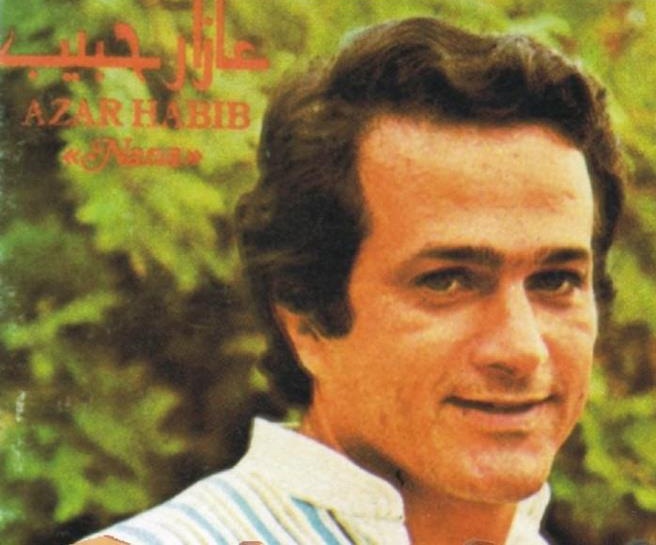
Azar Habib (عازر حبيب - also spelled 3zar 7abib):

Azar was born in 28th of November, 1945 in the small 'daia'ah' village of Al-Housh at the Rashia District. Then he moved with his family four years later to stay at the capital Beirut. He was a dentist by profession and education, but turned the buzzing trade's tools to that of another buzzing one: the bouzouki; a saz-like three-stringed instrument famous around the Mid-Rim region. His early starts were with a small pop band (Los Diabolos, then Los Cavalerios) playing acoustic guitar. His songs and albums were just marvelous, romantic sweet renditions of east-meets-west tunes sung in his famous cantor voice. Azar's songs are still listened to by many Arabs until this very day. He died aged 62 in October, 2007. Azar was and still is my favourite Lebanese singer of all time. And, to be honest, his voice is such a warm welcome change whenever I want to kick it off knocking-cool, or just feel some human warmth and happiness carried in a voice like his: so enchanting, beautiful, and true.

Enjoy!

Azar Habib - عازار حبيب.


Guys:
Don't miss the next post, aite? It's going to be the best ever Lebanese golden-hits compilation that has ever graced any page on the net (or, off of it). There you'd find and meet for the first time many artists, bands, unknown singers, etc... right from the late 60's till the late 80's! And the tote is going to up around 500 songs! Whews!


Lebanese 80's Mega-Collection: Comin' soon at the next Intermission.

Dig dawgs!

H.H.

P2P Sharity (Sharing Charity) on The Chopping Block.


Well, this sure as all 'ell is old newspapers to most, but I thought why not 'share' this mini-post after the aftermath of MegaUpload's closure which still resonates high and loud on the webbed world of the wonders in such an Orwellian 1984-style drama.

As we all know, there were many P2P file-sharing websites that got closed by mere 'reverberation'-like, knee-jerk reaction when a U.S. Justice Dept. high-court decided to 'seizure' MU and soon other FS websites like FileSonic, and Loaded.to joined the cabal.

The number of these sites is growing, and most are beginning to join the SOPA/PIPA (Stop On-Line Piracy Act/Protect IP Act) and the ACTA (Anti-Counterfeiting Trade Agreement) treaties. Wupload has just closed-shut its doors on any UL-DL-ing activities from its website. There are news from Germany that soon maybes... the monolithic, Austrian file-sharing website RapidShare will soon be shut down.

The list is as long as my arm of American sites that are shutting down like a virgin's legs seeing an erect cock: HotFile, FilePost, FileJungle/FileServe/UploadStation, EnterUpload, and DepositFiles are taking advance measures by shutting down most of their users' accounts in droves.

MediaFire has done this to a lesser extent, but stays the best website to UL-DL files at. They added a new service (MediaFire Express, which I had talked to you about a few days ago 'ere), and got itself a new face-lift.


Here are some of the few remaining sharity websites that still does a great job without having to close their services' doors on the end-user's face:

-DropBox.

-Oron.

-
Minus.


I saw many bloggers calling their blogging days over and away, and some are leaving 'their ships' in numbers. Still, let's keep our fingers turtle-flippin' and crossed in the meantime, because once the shit hits the fan, there would be no use of runnin'. As for me, I shall enjoy the music!


Stay hip y'all!

H.H.

3/31/2012

Intermission - Part I: Al-Balabil, Fahd Ballan, Dahmane El-Harrachi: Add-Ups & New Downloads.

How yer'all doin'?

This is the 'Intermission' where one can dig old posts anew with more uploads by some of the artists and bands that were featured here at The Audiotopia the past month.

It's my way to refresh the user's ability to always enjoy the music I post here, giving out new albums/songs/pics etc. It's all done for the sake of music after all.

A new month means, new posts and new uncovered music from the Middle-East region right here. Remember, this is jus' the beginning. The waiting list is really very long, and above all... most interesting. Music shall always stay perma-fresh here, guys. Be sure of that.


Here are more music from Al-Balabil, Fahd Ballan, and Dahmane El-Harrachi. (If we want to have these three in one word, what would this one word be? Al-Balmane? Ha!).

Note: Good news for all bloggers who also have their downloads dropped at MediaFire is, the site is getting a new trial 'Beta' version of its MediaFire Express to lessen the amount of naggity-naggin' upload time. I tried it at upping these three files hereunder and, yeah the can has what it says on the front-label: it's much faster now to upload any large files with ease and simplicity.


Stay tuned for more to come. And, meanwhile, you can enjoy the early days of spring-summer 'ere... at the
 дևծιστøρία with these wonderful tunes.

Diggity dig!


Al-Balabil: البلابل.
Al-Balabil - Sudanese Music.

Fahd Ballan - 40 Hits.

Dahmane El-Harrachi - Best of Collection.


If you wonder now... what's next on the 'Topia? Ohkay, wer gonnae spot-light anotha comin' Intermission post: Lebanese Hits from The 80's. Plus, half a dozen or so of these same Lebanese artists shall get separate downloadable albums right at
Lebanese 80's Pop - Part II. It'll be unbelievable! Trust you me. And, it will take us through the first few days of April until we start again with another 15 new artists/bands (psst! The first post will be a band from Turkey).
The famous Layali Beirut compilation.
Like the older Layali Beirut (An Evening In Beirut) comp, this one I'm going to compile will be enormous and lay to waste any attempt at looking for Lebanese 'golden-hits' anywhere else other than here. More hints for the Lebanese Music Comp? Funktacular music by Idgar Sam'an, Adonis Akel, Joseph Namnam, ... rock-pop 70's songs by rare Lebanese bands like The Bandalis, cool lost music by rare singers even Arab music aficionados* never knew their names from Adam and Eve!

Nice way to end the month and start afresh the new one with a bang, courtesy of yours, Hammer.

See ya roun' with mo' soun'!


*(One of my close friends here in Jordan is a Lebanese music collector who specializes in 80's-70's music. His name's Mutasim Shantir, and got gobshitesmacked at the huge volume of these artists; their rare songs, number of outtakes and rare cuts... I had to give him twice, a short-cut version of the multiple albums that I am busy compiling right now).

H.H.

3/28/2012

Intermission Post: More Middle-Eastasy Music!

Tell Fairuz and Nasri Shams Eddin the news:
the two classical figures of Lebanese music.

Good day 'ereybawdy.

Been keepin' it a-cool at the starters of the 'sprummer' season here in Jordan as the weather's gettin' nicer and meeker. That said, and looking back at this blog, I thought about adding some music to some of its posts to de-freeze it all into one, solid, unified directory for online users looking for music from the Middle-east.

Now, to make a long story short, this is what you'll be offered as an intermission before commencing with the next 15 posts at the Audiotopia:

Get ready for some 'lost' Al-Balabil music that I am sure will be a great add-up to the original post.

You shall get yourselves a new 'Best of' album to add for the earlier Dahmane El-Harrachi one/s. 


Fahd Ballan also gets the refurbishing treatment 'ere with a honoury album that features some songs not available on this post.

And, babes and babettes... 'member The Lebanese 80's Part-I? That will start to roll again with Parts II & III featuring some wham-bam, never-on-the-web albums by many Lebanese 80's singers like Elie Choueri, Azar Habib, Issam Rajji, Samir Yezbeck, Sammy Clark, Salwa El-Katrib, Feryal Karim, etc... plus a wow-inducing, 500+ song mega-collection of Various-Artists Comp from Lebanon that sure will be the last word on 70's and 80's Lebanese pop anywhere else in the entire world! Aye yep: You got that right on.

So, be there or be
□.

Get ready and rev up yer DL-ing enguns!


H.H.

3/20/2012

Dahmane El-Harrachi: Bluesman of Algeria? - دحمان الحراشي.

Howl-o, 'gain and welcome to another post at the Audiotopia.

Each country in the Middle-east has its own troubadour singer: Egypt has Chiek Imam, Morocco has Lhadj Belaid, Turkey has a ton of these and a half… Algiers has one, too: Dahmane El-Harrachi.

There is a beginning to every story, and ours begins with what made Algiers a country of immigrants when the first French troops arrived in that country in 1830. The population was fighting against this invasion writing with their blood (as most Arabs say there…) the story of a nation that went under the mercy of some foreigners for no reason at all: two Jewish ‘black-foot’ merchants were behind 'debt' for France which gave France reason enough to occupy the whole of Algiers.

Same as the Moroccan Lalla Aicha (or, Aicha Qandisha), there was another fighter woman in Algiers that stories of her resistance became legends sung for generations to come. Her name was Lalla Fatima N'Soumer, or simply Lalla Fatima. This woman has sparked many songs in both Morocco and Algiers. The Algerians were fighting for freedom, but with time, grew tired as the colonizers were depleting their country’s resources. That’s exactly what France wanted to do to Algerian Arabs: de-Arabize them by driving them from their villages and ultimately their country.

Soon, even their Arabic language was deformed into a strange vernacular that has more French words in it than Arabic ones. And, the colonizers didn’t stop at that, nah: they changed their culture into that of a wank-water, stupider-than-thou French one that bore their mark and their mark alone. Songs were the nation’s only solace at times like these: troubadours sang around the outskirts of the capital city Algiers (Ajjazaier - الجزاير), to make a living just like old country bluesmen did around the south... howlin’ their throats out about the injustices of the ‘man’, and how they wanted to be free.

Our singer El-Harrachi’s music harks back to early blues musicians, and Arabic ones in particular like Algerian chaâbi godfather, the famous Hadj M'hamed El-Anka. Harrachi was also influenced by many chaâbi 40's singers of his time: El-Hajj Menouar, Khelifa Belkacem, Shiek Bourahla, Shiek L’Arbi El-Annabi, Abdelkader Ouchala, etc. Dahmane also was a virtuoso who played the banjo and the mandole (a cross between a mandolin and an oud). Here's his story.

Dahmane El-Harrachi:
Dahmane El-Harrachi circa 60's.
Originally a Chaoui (from the Shawia region شاوية, part of the Aurès Mountains in east Algiers), Dahmane El-Harrachi (born Abdelrrahmane El-Amrani, 1925-1980, his nickname is a clipform diminutive of Abdel-Rahmane, and the Harrachi part was of him hailing from El-Harrach or harrach حراش district in Algiers formerly known as Maison-Carrée), was a kid in the southern Berber village of D’jilal, part of the Khanshala/Khenchela Province. His father Sheikh El-Amrani took the family and moved to Algiers the capital city in 1920 and settled in the El-Abiar district where he worked as a muezzin (prayer-caller in Muslim traditions), at Algiers' Great Mosque (El-Jema’a El-K’beir). His father being a muzzien has influenced his singing ability and gave him a pro bono, daily practice as he listened to his father shout the words of the athan/azan (prayer-call) five times daily.

Haj El-Anka maître du chaabi.
As a teenager in a colonized Algeria, Dahmane El-Harrachi was like any of the pre-Independence generation of young Algerians: throw the boy to the streets to learn a vocation or two, and become self-dependent because his father couldn’t support his family alone. So, the young Dahmane tooled around with his hands; working once as a cobbler/shoemaker (seven years), a receptionist, and a tram ticket-collector connecting El-Harrach in Bab El-Oued. Being a working kid around the streets of the capital Algiers gave him a panoramic ear-view of those ‘baladi’, or chaâbi singers, and when he turned 16, he played songs on the banjo (called there santir/santira) so brilliantly. It was during this period that he started some promising musical debut, including a troupe of amateurs giving concerts all over Algeria.
A Pathé Marconi early record.
School education certificate in hand, he left for France in 1949, staying first in Lille (five years), Lyon (three), the city of Metz (also three years), until he finally settled in Paris in the early 60’s playing at the famous Cafe Maghreb for the workers who worked at the Renault factory. Workers would rush to hear him sing, identifying with him and through his songs their blues and suffering away from their homeland. This is how it began to be known. Meanwhile, he has recorded his first album at Pathé Marconi in 1956.
Singing and playing his mandole at a wedding circa 70's.

His first song was titled ‘Behdja Bidha’ (meaning: White Algiers ‘will never lose its luster’) and he composed the song ‘Kifech Nennsa Belad El-Khir’ (How Could We Forget The Land of Plenty). Right after the liberation war of independence which cost Algiers one million martyrs in 1962, the immigration-appeal snapped and most Algerians left Algeria finally to go to France. This life away from their families in that country was full of sad life-stories of failures, hard trials, and ‘ghorbah’ or expatriation blues. These became songs that carry realities and sufferings of Dahmane's countrymen and gave him the much-deserved status of being a spokesman for that fringe of Algerian society who worked and lived around Paris where he settled in the early 60’s.
Dahmane El-Harrachi on the shores of Algiers 70's.

Attentive as an observer and vigilant in the middle of these workers, Dahmane has always avoided falling into the sordid ambiance. What contradicted his somewhat dissolute life that he sang about things both true and beautiful when he was really a pessimist. That’s the blues he helped build around the Casbahs of Algiers. The music of El-Harrachi kept some melodic lines a pensive reservoir of old-time proverbs and sayings drawn from the oral tradition of poetry. Chaâbi music "established" by El-Anka was full of allegories and semi-dialectal citations pumped into the ‘melhoun’ style of North African music. It’s that Dahmane used a more simplified everyday talk, understandable throughout the North African community. This explains, in part, his success.
Bluesman's pose circa 1965.
Chaïebi or chaâbi Algérois chansons popularized by Dahmane El-Harrachi bore the stamp of redjla (improvisation). He took the genre onto another level with his wisdom and especially rusty gravelly voice, modulated by alcohol and tobacco. He’s a story teller; the troubadour, the ever-traveling vagabond... He was a hobo bluesman singing in an Algerian dialect so simple, and being an impressive multi-instrumentalist (he was a virtuoso banjoist, mandolinist, tar-player, darbouka-touter etc...), Dahmane also sang chaâbi interpretation of old, classic tunes taken off the beaten track. Elegant drinker he's nicknamed the 'Aznavour' of Algiers by some, and others compared his playing to that of early country blues singers and players.

Djamel Chir, Dahmane El Harrachi
et Matoub Lounès 1980.
Discovered later on by the new generation, EI-Harrachi was treated to a Festival of Maghreb Music held in the late 70s at La Villette. He came back to an Algeria in the late 70's: this land that never ceases to evoke in him its way nicely images, and made two appearances before having a tragic ending, where in August 31, 1980 and in a return visit to his homeland he had a terrible car accident on the coastal ledge between Ain Benian (west of the capital) and Algiers. He was 54 years old when he died.
El-Harrachi from Saha Dahmane, 1970's.
Dahmane has a vast repertoire of songs. You can find here some significant extracts and tracks that I collected. He was part of a musical audio-documentary filmed in the 70’s, and directed by Hadi Rahim for Algerian ENTV Television (Saha Dahmane Haj Rahim, or translated roughly to ‘Thank You, Dahmane’) in which his most famous song Ya Rayah (You Who’s Gone Traveling), appeared on film sung by the man sitting on the shore, clutching his mandole. Recently, rai singer Rachid Taha honored him by 're-inventing' Ya Rayah into a shorter version that witnessed a huge popularity all around the world. But, nothing's like the old masterpiece itself.

At later days in early 70's.
Rachid Taha, echoing the famous song Ya Rayah of Dahamne El-Harrachi has maintained the memory of a major figure in Algerian popular music; one who keeps his gravelly voice intact to enchant an all-acquired company. Even Rachid's voice is a copy-act of Dahmane's own. The song itself deals with the problems faced by immigrant Algerians, hard-feelings, envy, etc... all these social pathologies that were left by a colonialist France years ago, asking his beloved folks to stick together and revert back to old traditions set by their good faith and ageless culture, and to go back to their homeland in simple, easily-understood words of qasid, or popular poetry.


Dahmane El-Harrachi performed concerts in China, Japan, New York, and Paris and other parts of the world. His son, Kemal El-Harrachi took his father's lead, and issued a debut album titled 'Gana Fenou' (He Sang His Art), in a thankful gesture to his father's music and unique artistry. True that: Dahmane's music will stay a living art the same as any blues singer's music that still resonate on for a long time after his death.


Si Dahmane, thank you! Saha!


Chaâbi Algérois - دحمان الحراشي

Note:For more information on the Algerian Chaâbi genre, try this wonderful blog. I also have to thank other blogs written in French for their useful help on making this post. Saha!

H.H.

3/19/2012

Dariush Eghbali: Iran's Frank Sinatra? - داريوش.

Hello...

We continue today with another post, but this one
for me at least, is going to be so special. After leaving Bahrain; this small island-state in the Persian Gulf (or, Arabian Gulf), we head towards the east to a land of musical diversity and history: Iran (إيران). Bahrainis are mostly Iranians by ethnicity. One in four Bahrainis speaks fluent Farsi. Our artist today is a figure of love and peace around the world, true, but he's much loved by Bahrainis as well as Arabs in particular (include me here).

On hindsight, I knew fer sure that this post was going to be the hardest blog-post that I'm going to do so far because I really admire today's singer, so much that I have no words to describe him: he's beyond words. There aren't any words fair enough; devoutly-just that could be used in a proper manner to even try and begin to describe this great legend in such a small place as a web-blog's window box.

So, allow me to give you my best shot at blogging about Dariush Eghbali.


Dariush:


(alternate spellings are Darius, Daryush, Daryoush, Dariyush, Daruosh, Darvish. Full real-name: Pedarash Mahmode Eghbali).
The always 'smoking-cool' Dariush.
For Dariush one becomes wordless, shtoom... silent. Only for his voice to keep itself in one's back-mind. His great voice is simply magic. I have sweet memories of that time when I first got introduced to his music by mere chance. And, then grew from just a listener to a faithful admirer. Now I reckon that Dariush lives somewhere in the deepest recesses of my heart this 'Sultan' of Persian music, this great man. How beautiful were those moments!
Dariush Eghbali  - داريوش اقبالي

Dariush when he was just a kid.
This great Iranian singer was born in Tehran on the 4th of February 1951, but the middle years of his early life were spent with his family on an island. His father Mahmode Eghbali was a well-known landlord who took the family to Karj (خارک), an island that sits 25kms from the Iranian coast on the north-eastern side of the Persian Gulf. Then, the family moved again almost 1000kms faraway to to the north Mianeh/Meyaneh in the East Azerbaijan Province. These early childhood travels had a grave effect on Dariush as he always thought of himself as a traveler (مسافر) through this transient life.
 
Dariush School picture.
The story of the early days of his musical career is still an enigma, but his first singing career steps were taken for the first time at the age of 9 in a school celebration-play called Shahrara ('The Spark') as it went on stage. Likewise in high school (Dbyrstanhayy Farabi), in Tehran he spent his time doing art school paid-programs. Hassanpour Khayat Bashi (a famous Iranian film director, T.V. producer and singer, too), saw the young man singing around Tehran's clubs where the young Dariush has finally settled in his early twenties in the late 60's and worked on the young singer's image because Dariush's voice was just spotless.

In his early singing career - early 70's.
That was Dariush's official entry into professional music in 1970 with a song he sang on a T.V. music show (Don't Tell Me You Love Me - آیا به من بگو عاشقمی). In the same year that he got on T.V. he made a song again called 'I Do Not Like to be Famous'. It is worth mentioning that Dariush, on the other hand, had a serious face (which got deformed later on by a nutcase fan who threw acid-water at him in late 70's).

Early picture of Dariush.
This made it plausible for directors to give him lead roles in their over-emotional films that were very popular back in the 70's. The early, so-called 'pre-revolutionary' times in Iran weren't any better than those post-revolution ones: the Shah's reign was known as a tyranny, but Iranians were able at least to keep a colourful lifestyle like any in the west. Singers with stage names such as 'Bobby' were carbon-copy prints of Elvis (ergh, Bobby Daren, maybes?) and a bunch more of these idiots saw some minor fame in the 60's, issuing their super-hits (سوبر هايت) records for a healthy music market in and out Tehran the capital.
Dariush Eghbali circa 1971.
Bashi's intention was to make another film star, but much to his surprise, Dariush became popular for being a singer when he sang his first song live on that popular T.V. show which was the norm. Oddly enough, Dariush wasn't discovered by another, more infuelntial T.V. presenter and producer Fereydoun Farrokhzad (who made famous such rising singers like Sattar, Ebi, Shohreh, Morteza, to name but a few).
The trio of Dariush, Keivan, and Afshin. 1973.
Dariush, on the other hand, sang his songs like nobody else did: wonderful, serene, heart-rending, love songs that didn't have that usual western influence to them, or what some call rather stupidly psych-funk beats. Dariush also played with other artists, and in the very beginning he formed a trio with singers Keivan and Afshin. He also sang in other trios with Atabi, Riza, Bahrouz, and duets with female stars like GooGoosh, Ramesh, Marjan etc. But, his most dramatically touching work is when he sings as a soloist. In one word? I really have none to describe it. God, it's sheer joy.

The real Iranian stars: GooGoosh and Dariush (Darioosh).

The songs were purely Iranian: neither old, nor new in style. That set him apart as something else like Frank Sinatra was in the west singing power 'croon' ballads in a modern way. His songs were catching popularity far speedier than most of those other also-popular singers because for Dariush, the best poets stood behind him, and gave him their lyrics to put to song knowing that their poems would start to take to life once Dariush's mouth started singing them. Few other Iranian singers like Fereydoun Foroughi shared this with Dariush as his brother was a famous Iranian poet.

Fereydoun, Ramesh, Dariush.
The Shah with his wife, Farah.
Most people weren't satisfied with the status quo and rule of the Shah; truly and probably, that's why every Iranian singer sang crypto-revoultionary songs to denounce this monarchy renowned for its lavish life, and fuckspensive extravagant spending. Even communist University students used to sing these in the mid-70' at the height of the anarchic student movement that swept the entire world a few years before. These singers and students got jailed by the Shah's security forces and most of the singers started to flee the country in numbers even before the Islamic revolution came after the killing of Khomeini's son Mostafa in 1977.

The revolutionary Islamist Guards.
These songs were books of poetry in all actuality: every word in these songs was put with utter care; every metaphor, simile, couplet was begging for its deserving singer to make them shine and resonate with life. Most of these singers were jailed for being such adventurous revolutionaries and both, Dariush and Fereydoun were jailed by the SAVAK (ساواک: Iran's C.I.A. arm) during the reign of the Shah of Iran Mohammed Riza Pahlavi before he got thwarted.
Dariush Eghbali.
That was very destructive to music and all sorts of arts. Then, it all began all over again when the Ayatoullah Rouhllah Khomeini took the ruling seat (Note: he's a Shii'te cleric leader who was brought by C.I.A. and French intelligence to power from his exile imposed on him by the Shah in Paris in an Air-France jet in 1978 so that the western powers could put their hands on Iran's resources which they still control, regardless of all the spinformation the media tries to throw your way these days about Iran's nuclear weapons threat which is just a sham), and then after the coup, Iran turned its head away from art and music. Unfortunately, the story still continues today.
Dariush on T.V., 1976.
Music-wise, Dariush also drank from the same ancient conium that is Persian devotional poetry: he didn't sing only patriotic, nationalistic songs, but took his words from more than one poet like Jalaludeen El-Rumi, Hafiz Ahmad, Nader, Shamloo and collaborated with Ahmad Pejman, Mohammad Shams, Farid Zoland, Varojan and many other innovative and avant-garde lyricists, musicians, and composers to make music.
The best singer at his best.
His works took stem and shape from lyrics of pious never-heard men like Naderpour, Jannati Ataei, and Bayat Ghanbari, and unknown, poor poets like Simin Behbahani, Ardalan Sarfaraz Hussain, Shahyar Ghanbari and Iraj Jannati. He called upon the words of Galilee and Farid Zealand, composers Babak Bayat, Esfandiar Monfaredzadeh, Hassan and also worked with other less-known composers like Shamaizadeh and Babak Afshar.


Live on Iranian T.V..
This was due to his songs being not only sung about his love for his country that became the feast for colonialist powers and minority Shii'tes (they make only 47% of the population, by the way), but also about love and lovers, lost promises, broken hearts, and vacant souls. These themes were a constant humane necessity written through the ages in a place like Iran so rich with its history of ageless art and passionate poetry. But, after the Islamic Revolution (1976-1978), and when Iran became an 'allegedly' Islamic Republic (جمهوري إسلامي إيران), the ban of all pop music, songs, bands, halls, records, poetry, art, artists, you name it... put a curb on Dariush's work, so he decided that the time was ripe to move again, this time leaving his native beloved homeland alltogether in October, 1978 for England returning back only in 1985.
Dariush Eghbali in the late 70's.
His 25 albums are all on record: an evidence of his exceptional work and devotion to music. Dariush has starred also in two Iranian films: "The Friends" (Yaran), and "The Cry Under Water" (Faryad Zir Abe). His films were honoured recently by a festival for Dariush hailed by the organizers in nearby Bahrain as "Iran's representative for contemporary music" and was awarded the Highest Peace Trophy as a token for his efforts for world peace. Dariush has been giving concert after concert in recent years outside of Iran in places like the U.S., England, Germany, Canada, France, Holland, and has performed concerts in Japan.

Yaran film Poster.
Cry Under Water Poster.
These works of art still resonate with his 'trill-like' voice, and unbelievably beautiful arrangements. Some of his songs are bitter-sweet melodies sung by a pained heart. His heart. This man was truly Iran's best singer ever. And, his voice is still enjoyed by millions of Iranians all across the world, wherever they might be far from their homeland and beloved Iran, Dariush's voice reminds them of it.


Dariush Eghbali: The 'real' Iran.
This man's entire being was singing the words of the poems, until he himself became the poem. Dariush is not just a singer: he is the love that stood the hardships of an Iran that got torn after so many years of colonialist and extremist tyranny. Not a single Iranian hates Dariush's music. He is loved by every one. He is a poem. He is the song of Iran. He is the real Iran. That's him.
Forever.

Singer and the love of Iran, Dariush.

Addendum:
-His Addiction:
Dariush after the attack.
Dariush and wife Venos, receiving
the Rev.Ronald L. Wright's
Award in 2005.
He was addicted to morphine after he was hospitalized from second-degree burns from a fan's attack. At that time (and according to his story) Dariush had little familiarity with any drugs. He overcame addiction and wanted to be active at combating drug addiction, and therefore worked with the Ayeneh Foundation which he himself helped establish and the Iranian Recovery Center. He came to personal levels with the help-recovery and recovery process of addicts and founded a chat site called Xerxes, plus his organization's own website-chat and help-line behboudichat.com. The foundation has already helped forty-thousand addicts who have addictions in Iran alone. He was awarded the Ron Simmons And Rev.Ronald L. Wright's Award for his distinguished efforts. Dariush is a member of AI (Amnesty International), and still through his voice, fights the shadows of evil, power, drug-abuse, poverty throughout the world.


Dariush singing in the 70's.
I hope that this post has shed some light on Dariush Eghbali's life, music, and accomplishments. He's a married man now who lives with his wife Venos, and beautiful little daughter Melad.
Dariush Eghbali in the 80's.
I know one thing 'nd one thing I know... Dariush himself is the best. Really. Dariush has no 'best-hits' and all that crap. His songs are the best. Down 'ere you will find 8 of his albums. Yeah, you heard that right. And to cover the whole nine yards (as one Americanism goes...), his Singles are to be found, too. Bonus, I hear? A separate single-album (Ahay Mardome Donya).

Dig it, babes!

Download all the 8 albums and singles from here.


F.n.: Some lyrics and a few video clips are to be found here complete with various downloadable links. Sadly, Dariush's official website is down at the moment, but do dig this humble homage to such a great icon of art, love, and music here and only here at Audiotopia.

Lots of love!

H.H.